Much like the above gif of Austin Nichols here I am, rolling back into your lives this afternoon -- forgot I had a screening this morning. (If you'd like to know what it was and a brief snippet of what I thought of it check out Bluesky here.) Anyway on top of that it's also the Opening Day of both NewFest and the Brooklyn Horror Fest and so it might be a little quiet, this post besides. October is always a lot! Let's see how it goes...
I'm not just saying this because I am me and it's so me to say this, but I'm actually pretty shocked that the shot in Andrew Haigh's A Long Winter where Fred Hechinger and Kit Connor are getting dressed for bed and stand beside each other shirtless with their extremely different physiques on display is not included in the just released trailer for the movie -- the moment does serve a meaningful purpose in the movie, even if it's also just a little gratuitous in the sense that Andrew Haigh knows who his audience is, and when I saw the movie at NYFF I was likie, "Ooh trailer shot." But no they slapped me right across the face and said "Boo Whore" instead, and I am fine with that -- it's not that kind of movie. (Although any Ebon Moss-Bachrach fans might want to get in line and stay in line, just saying.)
Anyway I didn't get to review this out of NYFF because it'd already been reviewed at Pajiba out of TIFF, but if I had reviewed it I would have been Team This Movie -- it's very quiet and gentle, it's like snow falling, but if you can get on its wavelength it's a terrific addition to the canon of Sad Mom Cinema. (Indeed I have a feeling it might wreck my partner, who vibes hard with such.) Fred Hechinger is wonderful in it, giving a real surprise of a performance -- not that I am surprised he's good, Fred is always good. But you don't at all expect his character to be such a beacon of light given his circumstances and yet Fred plays everything with a little more wonder and kindness than you expect . And it really took me off-guard, in a good way. And it's not going to happen (this movie is shamefully going to slip through the cracks of the next few months, I can already tell) but the best performance in it belongs to Bachrach, and he really deserves some awards-season appreciation. A Best Supporting Actor nomination at the Oscars would be richly deserved but I won't be holding my breath. Anyway the movie hits NYC on December 4th and then exapands outward on January 22nd and as with anything made by Andrew Haigh you should see it.
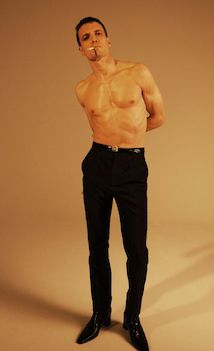
Listen -- if they wanna drop one photograph from this photoshoot of Dino Fetscher per day for as long as I live and blog well then we'll be getting a "Good Morning, World" post that is Dino Fetscher every damned day. I do not just take this bait -- I revel in it, I roll around in it like a low-down dirty dog, I do. Good morning! I'm feeling better than I was yesterday. Passed out early, got up late -- I really do think there should be an entire week of rest per year where everything shuts down and everyone just lays around. It would do our brains good dammit. (click to embiggen)
Hey, you. So I got back to my desk this afternoon after a wonderful (early, early) morning spent in the presence of Greta Gerwig and Stephen Colbert talking about the new Narnia movie (see below) and I immediately hit a wall. It's been a long month y'all. Anyway I wasn't going to post anything at all but then I remembered that the above old photo of Daniel Craig exists and I decided to give us something to look at until tomorrow. Well besides my noted Bluesky braggadocio:
I will do a round-up of my New York Film Festival reviews some time this week now that the fest has ended -- it was one of the best years I've had at the fest in the decades I've been going, with so many incredible movies that I couldn't even get to writing about, so I actually have a second post in mind as well; we'll see if I have time what with both NewFest and Brooklyn Horror Fest starting in a couple of days, but I hope I do so I can give all the great movies their due credit. But for now I've finally written up a few, deeply inadequate thoughts on what is my favorite movie coming out of the fest (and I don't just mean NYFF, I mean "the year" at this point), Ryûsuke Hamaguchi’s All of a Sudden -- read my review right here. Even after I named his previous movie Evil Does Not Exist my favorite film of 2024 I somehow keep underestimating Hamaguchi (I almost missed seeing this new one entirely) but that ends now -- what an absolute thing of beauty, this film. I haven't stopped thinking about it for weeks. Neon is releasing it on November 25th and you have to go; here is the trailer:
A happy birthday to actor Mia Threapleton today -- yes yes she's high-nepo being Kate Winslet's daughter but she was so wonderful in this wonderful movie that I can't hold it against her. Actually it's kind of weird that Kate Winslet has never been in a Wes Anderson project isn't it? I could see her excelling with his tone -- whenever she leans into comedy she's grand at it. (The Regime had a semi-Andersonian tone to it actually.) Maybe this was Wes trying to get at Kate. I could picture an entire film by Wes Anderson starring nepo-babies though -- they'd all have that slightly familiar air of their parents but a little off-kilter, which is what Wes Anderson Movies are in a nutshell basically. They always feel like things that previously existed, unearthed tchotchkes from the past made new through his weird and wonderful sensibility. Anyway this is just reminding me how deeply underappreciated The Phoenician Scheme was in 2025 -- how the Oscars keep existing when Wes Anderson movies don't get nominated for at the very least Best Production Design every single time he has a new movie out is to their eternal shame. I did my part, it was in my Top 20 movies of last year!
Irish actor Fra Fee (and yes we just did a post last week debating the whole "openly gay" thing with our self re: him) just got done doing a theatrical show called I'll Be Seeing You in Scotland, and our laddy was kind enough to share a few photos from... well from his time getting dressed and undressed in the dressing room for the most part. This is why we need gay stars! They are like us! And they know what the people want. So let's enjoy these photos whilst I re-settle myself into my seat for this post-NYFF week, shall we? We shall, after the jump...
I literally just reviewed Fjord earlier this week for the New York Film Fest -- read that here -- but for once I was not speaking from an ivory tower! No you, the common people, can go see Fjord this very weekend yourselves! Well you can if you're a "common person" in New York or Los Angeles anyway. Fuck you, Maryland. Sit and spin, Idaho! Ahem. Anyway you should see Fjord whenever you have the chance because, like everything director Cristian Mungiu makes, it's very good. As for me, well, I've got one more NYFF movie to see tomorrow and at least one more NYFF review to write (see all my NYFF coverage to date here and then it's on to the Brooklyn Horror Fest and NewFest which both kick off next week. This is a mad time of year, as ever. But mostly I have a quiet weekend ahead and I plan to take full advantage, zone the fuck out, and watch that dumb monster show starring Josh Hartnett on Netflix. Tis the season!
Okay well obviously I'll be binging BELOW this weekend
I sure hope the world doesn't explode in the next twelve hours because golly I will look like a fool, posting this post from Thursday evening to go up in the theoretical postapocalyptic world of this Friday A.M. I have posited. That's the danger of pre-planning posts in 2026! Anyway I've got my final press screening of the NYFF this morning -- for the Closing Night film, Ava Duvernay's follow-up to her documentary 13th called you guessed it14th -- so I'll be in a little late. This isn't my final screening of NYFF -- I'm catching at least one more over this final weekend -- but it's the last one you people have to worry about keeping me from you. Even through a possible apocalypse! The theoretical things I do for the movies. Anyway look -- it's George MacKay! More MacKay (via) even after we've gotten such a fine and hefty bunch as of late thanks to next week's new Sense and Sensibility movie, in which as I have already said he is delivering a real swooner of a turn. Feel free to enjoy these new photos after the jumpin any manner you like til I'm back in my seat again...
There, a photo of the handsome and talented Yura Borisov to ease you into something much more volatile -- aka my review of Luca Guadagnino's Artificial, which just dropped at Pajiba after its world premiere at the NYFF. Go forth and read! (Also I'm a little sad I had to cut a bit mentioning how two characters in the movie poorly quote Radiohead's song "Paranoid Android" -- just know that moment pierced my deepest soul.)
Apparently I was in such a daze yesterday from the dentist jackhammering my face for two hours that I got back to my desk and completely forgot to post again after Noon -- whoopsie, but especially whoopsie because I should have linked to another review of mine from the New York Film Fest that dropped. I wrote up my thoughts on Paweł "Cold War" Pawlikowski's latest Fatherland, which stars the one and only Sandra Hüller (yes her again) as writer Thomas Mann's daughter Erika, right here -- read it! I didn't mention the fact that this movie is a mere seventy minutes long and yet it left such an impression on me -- far more than some bloated nonsense like oh say The Odyssey, for example. You heard me! Although it might be more apt to take a dig at Digger in this context given that movie also stars Hüller and somehow managed to get a bad performance out of her. Now that that movie flopped I've seen a lot of people trying to play devil's advocate and come out in support of it and... can we just not? Let's let that one rot on the vine.
I just find it interesting that people are able to write about Tom Cruise movies without mentioning the fact that the man HAS SLAVES is all. Interesting!
While I recover from the dentist's chair this morning here, enjoy these photos and videos that I took at the Q&A that followed yesterday's NYFF screening of Luca Guadagnino's latest film Artificial. Twasn't just Luca as advertised -- actors Yura Borisov, Ike Barinholtz, and (eventually, he was late) Cooper Hoffman were all there as well! Obviously I will have more to say on the movie soon. Right now I'm just waiting for feeling to return to the right side of my head.
Posted some more photos and videos from today’s ARTIFICIAL screening at #NYFF this afternoon! Here: www.instagram.com/p/DeLQcJCjtp... — and here for you Cooper Hoffman lovers a quick video of him scampering onto stage late:
"I too quit smoking (2013) AND find this type of pictures cool. Also, PSA: if you're feeling like you want to start smoking again, just remind yourself "I do not want my body and house to stink like stale horseshit", then go drink one more glass of water to entertain your hands and lips. Congrats, btw."



 Posts
Posts